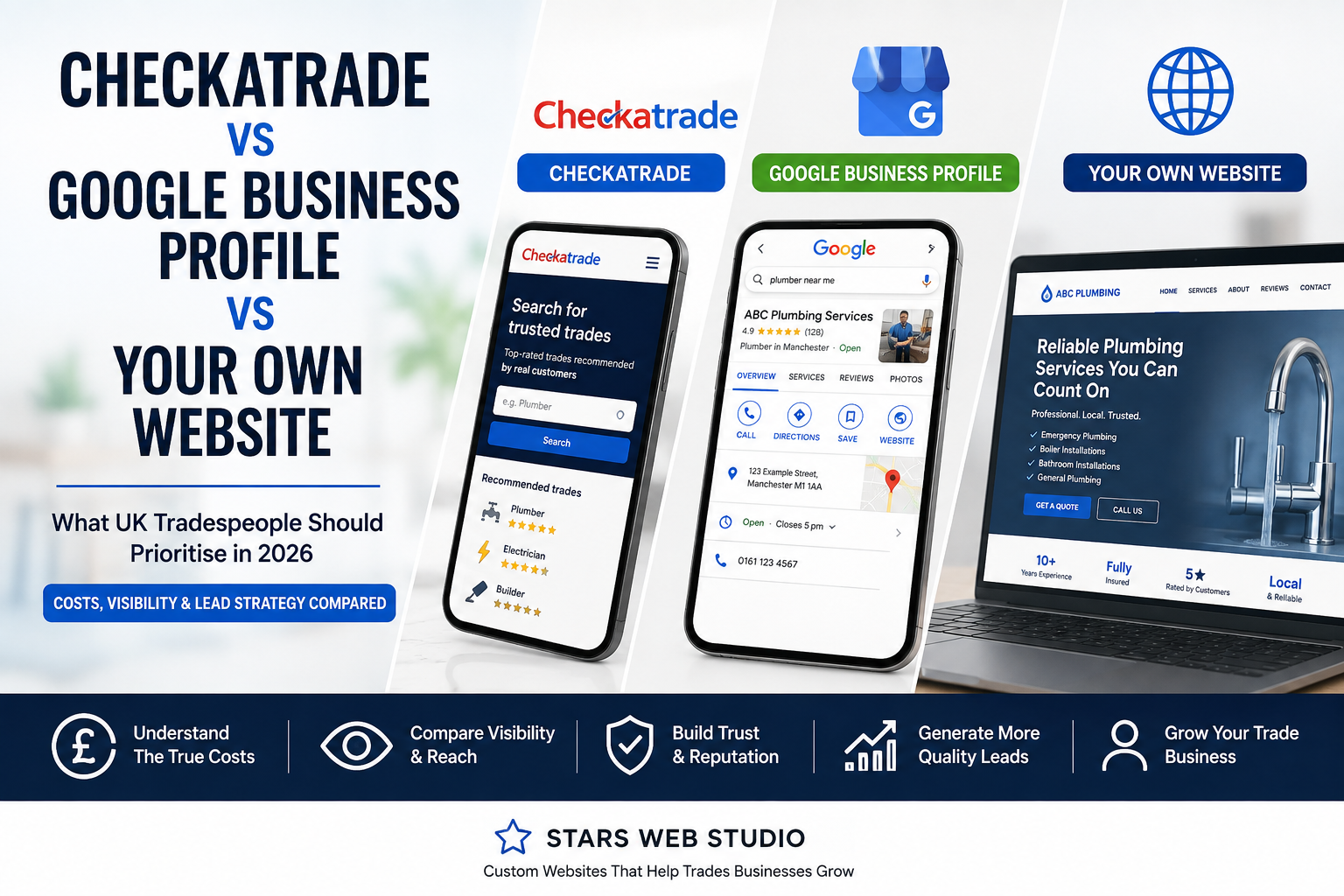
Checkatrade vs Google Business Profile vs Your Own Website: What UK Tradespeople Should Prioritise in 2026
Should UK tradespeople prioritise Checkatrade, Google Business Profile or their own website? A current 2026 comparison of cost, control, visibility and lead strategy.
Article guide On this page
Short answer: for most UK sole traders and small trade businesses, the strongest order is usually Google Business Profile first, your own website second, and paid directory spend such as Checkatrade only when you can prove it produces profitable booked work. That is not a universal rule. A new business with no reviews may get value from a trusted directory sooner, while an established tradesperson with strong referrals may benefit more from improving their website and Google presence.
Platform details and prices in this guide were checked on 17 August 2026. Always re-check current terms before making a buying decision.
If you are a plumber, electrician, roofer, builder, landscaper, decorator, heating engineer or another UK tradesperson, it is easy to treat Checkatrade, Google and a website as competing versions of the same thing. They are not. They solve different parts of the customer journey.
This guide compares the three channels using current information from Google, Checkatrade and UK consumer-regulation guidance, then gives you a practical way to decide where your next marketing pound should go.
The Three Channels in One Minute
| Channel | Main job | What you control | Direct platform cost | Best use |
|---|---|---|---|---|
| Google Business Profile | Local discovery on Google Search and Maps | Your profile information, photos, services, hours and responses | Free | Getting found locally and building review visibility |
| Your own website | Explaining, proving and converting | Brand, pages, services, projects, forms, messaging and tracking | Varies by build, hosting and maintenance | Turning interest and referrals into direct enquiries while building an owned web presence |
| Checkatrade | Directory discovery, trust signals and lead generation | Your profile within Checkatrade's platform and the plan you buy | Free profile available; paid plans currently start at £30/month | Adding another source of visibility, reviews and enquiries when the economics work |
The important point is that you do not have to choose only one. The better question is which channel should do which job for your business?
1. Google Business Profile: The Local Visibility Foundation
Google Business Profile is the free listing that can appear in Google Search and Maps. Google explicitly supports both storefront businesses and service-area businesses. A plumber who travels to customers, for example, can use a service-area profile and hide a residential address rather than presenting a home address as a customer-facing location.
Google says local results are mainly based on relevance, distance and prominence. You cannot simply pay Google for a better organic local ranking. Complete and accurate business information, reviews, links and wider web information can all contribute to how Google understands and presents a local business.
For a UK trade business, a well-maintained profile should normally include:
the correct business name;
the right primary and additional categories;
accurate phone number and opening hours;
the genuine service area;
services you actually provide;
real job and team photos;
customer reviews and thoughtful responses;
a link to the business website when you have one.
Google also states that it can source Business Profile information from publicly available web content, including a business's official website. That is one reason a website and a Google Business Profile should be treated as complementary rather than competing assets.
Official source: Google's local ranking guidance and Google's service-business guidance.
Where Google Business Profile is strongest
You want local visibility without paying for a directory subscription.
Customers commonly search for your trade plus a town, postcode or 'near me'.
You have real customers who can leave genuine reviews.
You need calls, directions, booking links or website clicks from local search.
Where it is limited
A Business Profile is powerful, but it gives you limited space to explain a complicated service, show detailed case studies, control the full customer journey or create dedicated pages for high-value services. You are also operating inside Google's interface and policies rather than on a platform you fully control.
2. Your Own Website: The Place You Control
A website has a different job. It should take someone who has heard of you, seen you in Google, found your van, received a recommendation or discovered you elsewhere and give them enough confidence to contact you.
For a tradesperson, that does not require a 50-page corporate website. A useful site needs to answer practical questions quickly:
What work do you do?
Where do you work?
Are you qualified, insured or accredited where relevant?
Can I see examples of your work?
What do previous customers say?
How do I call, request a quote or book?
Do you handle the specific job I need?
The major advantage is control. On your own domain, you can create detailed service pages, publish project examples, explain specialist work, show real photographs, add quote forms, connect analytics and change the customer journey as the business grows.
A website also gives Google more crawlable information about the business. Google's own Business Profile documentation says its local information can be compiled partly from crawled web content such as an official business website.
None of this means simply owning a website guarantees rankings or leads. A slow, generic or unclear website can produce very little. The site still needs useful content, sound technical foundations, genuine local relevance and a clear conversion path.
What a trade website should prioritise
A clear trade and location proposition near the top of the homepage.
Dedicated pages for genuinely important services instead of one vague list.
Real project photos and useful descriptions.
Relevant qualifications and accreditations displayed accurately.
Genuine reviews or links to verified review profiles.
A tappable phone number on mobile.
A short quote or booking form.
Consistent business details across the website and Google Business Profile.
Fast, mobile-friendly pages.
Basic analytics or lead tracking so you know whether the site is producing work.
3. Checkatrade: A Third-Party Discovery and Trust Channel
Checkatrade is not simply another version of your website. It is a UK trade directory and marketplace where customers can search, compare profiles, review trades and, depending on the product, request quotes or book work.
As of 17 August 2026, Checkatrade's official pricing page lists:
Free — £0/month: a business profile for collecting and displaying reviews;
Approved — £30/month: adds the Checkatrade tick, directory presence and other tools;
Growth — from £59/month: adds lead-volume options, booking features, search credits and performance tools.
Checkatrade says Growth pricing can vary according to factors such as the work and postcode areas you select. Its paid products therefore need to be judged using your own lead and booked-job data rather than a generic claim that the platform is either 'worth it' or 'not worth it'.
Official source: Checkatrade's current pricing page.
Where Checkatrade can be useful
You are new and need an additional place to build visible reputation.
Your ideal customers actively use trade recommendation platforms.
You want another enquiry source alongside referrals and Google.
You can track which leads become quotes, booked jobs and profit.
Your profile, photos, reviews and availability are strong enough to compete inside a marketplace.
What to remember about directories
A directory is a third-party channel. Its pricing, features, ranking systems and policies can change. That does not make it bad; it simply means you should treat it as one part of your acquisition mix rather than confuse it with an asset you fully control.
The UK's Competition and Markets Authority has also issued guidance for trader recommendation platforms covering areas such as vetting, monitoring, complaints and reviews. From a tradesperson's point of view, that is another reason to understand exactly what a platform verifies and what value your membership is buying rather than relying on a badge alone.
Official source: CMA guidance on trader recommendation platforms.
Google Business Profile vs Website vs Checkatrade: What Each One Actually Does
| Question | Google Business Profile | Your website | Checkatrade |
|---|---|---|---|
| Can it help people discover you locally? | Yes | Yes, through organic search and referrals | Yes, through its directory and related visibility |
| Can customers review you? | Yes | You can display testimonials and review links | Yes |
| Do you control the full design and messaging? | No | Yes | No |
| Can you create detailed pages for every important service? | Limited | Yes | Limited to platform features |
| Can you track your own forms and on-site behaviour? | Profile performance data is available | Yes, with your chosen analytics setup | Platform performance tools vary by plan |
| Do you keep the channel if you stop paying the platform? | There is no subscription fee for the profile | Yes, if you control the domain and content and keep hosting active | Paid features depend on the membership or product |
So Which One Should a UK Tradesperson Prioritise?
There is no honest one-size-fits-all answer, but this sequence is a sensible starting framework.
If you are just starting
Set up and verify your Google Business Profile correctly first. It is free, it gives you a local presence and it creates a place to start collecting genuine reviews. Then create a simple professional website so referrals and Google visitors have somewhere to verify your services and contact you.
Consider Checkatrade after that if you want additional lead flow or trust signals and the plan fits your budget.
If you already get work through word of mouth
Your biggest opportunity may be conversion rather than discovery. People who receive your name may still search your business before calling. Make sure they find a current Google profile and a website that confirms your work, location, credentials and contact details.
In this situation, paying for more leads before fixing a weak online presence can simply send more people into a poor conversion journey.
If you are established but want more profitable jobs
Do not optimise only for enquiry volume. Use your website to give high-value services proper pages and proof. Track which services generate calls and quote requests. If Checkatrade produces profitable work in your area, keep it; if it produces the wrong jobs, compare its real cost per booked job with your other channels.
If you are trying to grow a team
You need diversity. Depending on one source of work creates concentration risk. A growing trade business may use referrals, Google Business Profile, an owned website, directory platforms and paid search together, but each channel should have a defined role and measurable outcome.
The Metric That Matters: Cost Per Booked Job
Do not compare channels using impressions, profile views or website visits alone.
For any paid channel, calculate:
Cost per booked job = total channel spend ÷ number of jobs actually won from that channel
Then go one step further:
Return = gross profit from jobs attributed to the channel − channel cost
For your website, include sensible costs such as build, hosting, maintenance and any SEO or advertising you are actually paying for. For a directory, include membership and paid add-ons. For Google Business Profile, the platform itself is free, but you may still choose to spend time or money managing it.
This prevents a common mistake: celebrating ten enquiries from one source when only one became a worthwhile job, while ignoring another source that produced three enquiries and two profitable bookings.
A Practical 90-Day Setup for a UK Trade Business
Days 1–14: Fix the foundation
Claim and verify the correct Google Business Profile.
Use the correct service-area or storefront setup.
Check phone number, hours, categories and services.
Add real photographs.
Start a consistent process for requesting genuine customer reviews.
Days 15–30: Fix the website
Make your trade and service area obvious.
Create useful pages for your highest-value services.
Add real projects, qualifications and reviews.
Make calling and requesting a quote easy on mobile.
Connect basic lead tracking.
Days 31–60: Establish a baseline
Record where every enquiry came from.
Record which enquiries became quotes.
Record which quotes became paid jobs.
Identify the services and areas producing the best work.
Days 61–90: Test paid acquisition carefully
If you need more work, this is the point to test a paid directory plan, paid search or another acquisition channel with a defined budget and target. Do not judge it after one good or bad lead. Track enough activity to understand cost per booked job and job quality.
Five Mistakes That Make All Three Channels Weaker
1. Different business information everywhere
Keep core details accurate and consistent. Your website should not show old opening hours while Google shows new ones.
2. Creating a fake storefront
Google has specific rules for service-area businesses. If customers do not visit your address, follow the service-area rules rather than using a residential address as if it were a public shopfront.
3. Buying leads without tracking jobs
A lead has no value until you know whether it becomes work at an acceptable margin.
4. Building dozens of thin location pages
If your website targets several towns, each page should provide genuine local usefulness rather than replacing one town name with another across duplicated copy.
5. Relying on only one source of work
Referrals can slow down. Directory pricing can change. Google rankings can move. A resilient business develops more than one dependable route to the customer.
Our Recommendation for Most UK Trades
Think of the three channels as a stack rather than a fight:
Google Business Profile for local discovery.
Your website for proof, detail, conversion and an online presence you control.
Checkatrade when it adds profitable incremental work.
That order is a strategic recommendation, not a ranking guarantee. The correct mix depends on your trade, postcode, reputation, job value, competition and capacity.
The advantage of this approach is that it avoids two extremes: paying indefinitely for every lead without building your own presence, or assuming a new website will magically rank and fill the diary without reviews, local relevance or promotion.
Frequently Asked Questions
Can a UK tradesperson appear on Google without a website?
Yes. Eligible service-area and storefront businesses can create and verify a Google Business Profile without having a website. A website is not a requirement for the profile itself. However, a website gives customers more information and gives Google another public source of information about the business.
Is Google Business Profile free?
Yes. Google's official guidance describes Business Profile as a no-charge way for eligible businesses to manage how they appear on Google Search and Maps.
How much does Checkatrade cost in 2026?
At the time this guide was checked on 17 August 2026, Checkatrade listed a Free profile at £0/month, Approved at £30/month and Growth from £59/month. Features, pricing and promotions can change, so check the official pricing page before relying on these figures.
Is Checkatrade better than having a website?
They do different jobs. Checkatrade can provide directory visibility, reviews and leads inside its platform. Your own website gives you much greater control over your brand, services, project evidence, conversion journey and content. Many businesses can use both successfully.
Should I cancel Checkatrade after building a website?
Not automatically. Measure it. If Checkatrade produces profitable booked work that you would not otherwise receive, it may deserve a place in your marketing mix. If the economics are poor, you then have evidence for reallocating the budget.
Does a website help Google Business Profile?
Google says Business Profile information can be compiled from sources that include crawled web content from a business's official website, and Google also says web prominence can contribute to local ranking. That makes a consistent, useful official website a sensible companion to a Business Profile, although it does not guarantee a particular ranking.
Final Takeaway
For most UK tradespeople, the goal should not be to 'beat Checkatrade' or to rely entirely on Google. The goal is to build a customer-acquisition system you can understand and measure.
Start with the free local foundation. Build a website that proves what you do and makes it easy to enquire. Then pay for additional visibility only when the numbers justify it.
If you want to see what a conversion-focused trade website could look like before committing to a rebuild, browse the Stars Web Studio portfolio and request a free demo built around your real services, location and business details.