How Much Does a Small Business Website Cost in 2026? (UK, Ireland, US & Canada)
Real 2026 prices for small business websites across the UK, Ireland, US and Canada. What each price band actually buys, the ongoing costs nobody mentions in the quote, and our own rates published openly.
Article guide On this page
Short answer: in 2026, a professionally built small business website costs roughly £500 to £4,000 in the UK, €600 to €4,500 in Ireland, $800 to $6,000 in the US, and CA$900 to CA$7,000 in Canada. DIY builders like Wix or Squarespace run around £240 to £360 a year once you add a domain and a business email address. Agencies start around £2,500 and climb quickly from there.
That is a wide spread, and the spread itself is the problem. Ask three companies to quote for the same website and you will often get three numbers that look like they belong to three different products. This guide explains why that happens, what each price band actually buys, and — unusually for a guide like this — exactly what we charge, so you have at least one real number to measure the others against.
Why three quotes come back so different
Because small business website is not a specification. It is a category, and it covers everything from a single page with a phone number on it to a multi-location site with online booking and a payment gateway.
There are four routes to getting a website, and they are priced on genuinely different things.
A DIY builder charges you for software. You supply the labour: the writing, the layout decisions, the photo sourcing, the SEO settings, the ongoing fiddling. The subscription is small. The time cost is not.
A freelancer charges you for their hours. UK industry guides published in 2026 put this at roughly £800 to £3,000, with a straightforward four-to-five-page build usually landing between £1,200 and £2,000. Quality varies more here than anywhere else in the market. Some freelancers are excellent designers, others install a template and send a nicer invoice.
A small studio charges for hours plus a process. Design, content, SEO structure and testing are handled rather than assumed. Published ranges usually sit around £1,500 to £4,000.
An agency charges for hours, process, and overhead: account managers, offices, project managers, new business teams. UK guides commonly report £2,500 to £10,000 for a standard small business site, with London agencies charging noticeably more for an identical specification.
None of these routes is wrong. They are aimed at different businesses with different amounts of time, money and complexity. What is wrong is being quoted agency prices for freelancer work, which happens more often than it should.
What each price band actually gets you
Under £500 / €600 / $800 / CA$900
Usually a template with your logo dropped in, or a DIY build you finish yourself. Fine for a side project or a business testing an idea. The common failure is that it looks acceptable on a laptop and falls apart on a phone, which is where most of your visitors actually are.
£500 to £1,000 / €600 to €1,200 / $800 to $1,600 / CA$900 to CA$1,800
A properly built small site. One to six pages, mobile-first, with working contact methods and sensible SEO structure. This band covers the large majority of local service businesses: trades, salons, cafes, clinics, consultants. If your site's job is to make you look credible and make you easy to contact, you do not need to spend more than this.
£1,000 to £3,000 / €1,200 to €3,500 / $1,600 to $4,500 / CA$1,800 to CA$5,500
Now you are paying for things that do work rather than just display information. Online booking connected to a real calendar, automated enquiry replies, written content for each service, ongoing SEO after launch. Worth it when enquiries are already coming in and the admin of handling them has become the bottleneck.
£3,000 and up
Custom functionality. Ecommerce, member areas, multi-location sites, integrations with booking or CRM systems, or a genuinely bespoke design. Real reasons exist to spend here. It felt like the serious option is not one of them.
What we charge
Most guides on this subject are written by companies that will not tell you their prices. We publish ours, in your own currency, with no consultation call required first. Full details are on our pricing page.
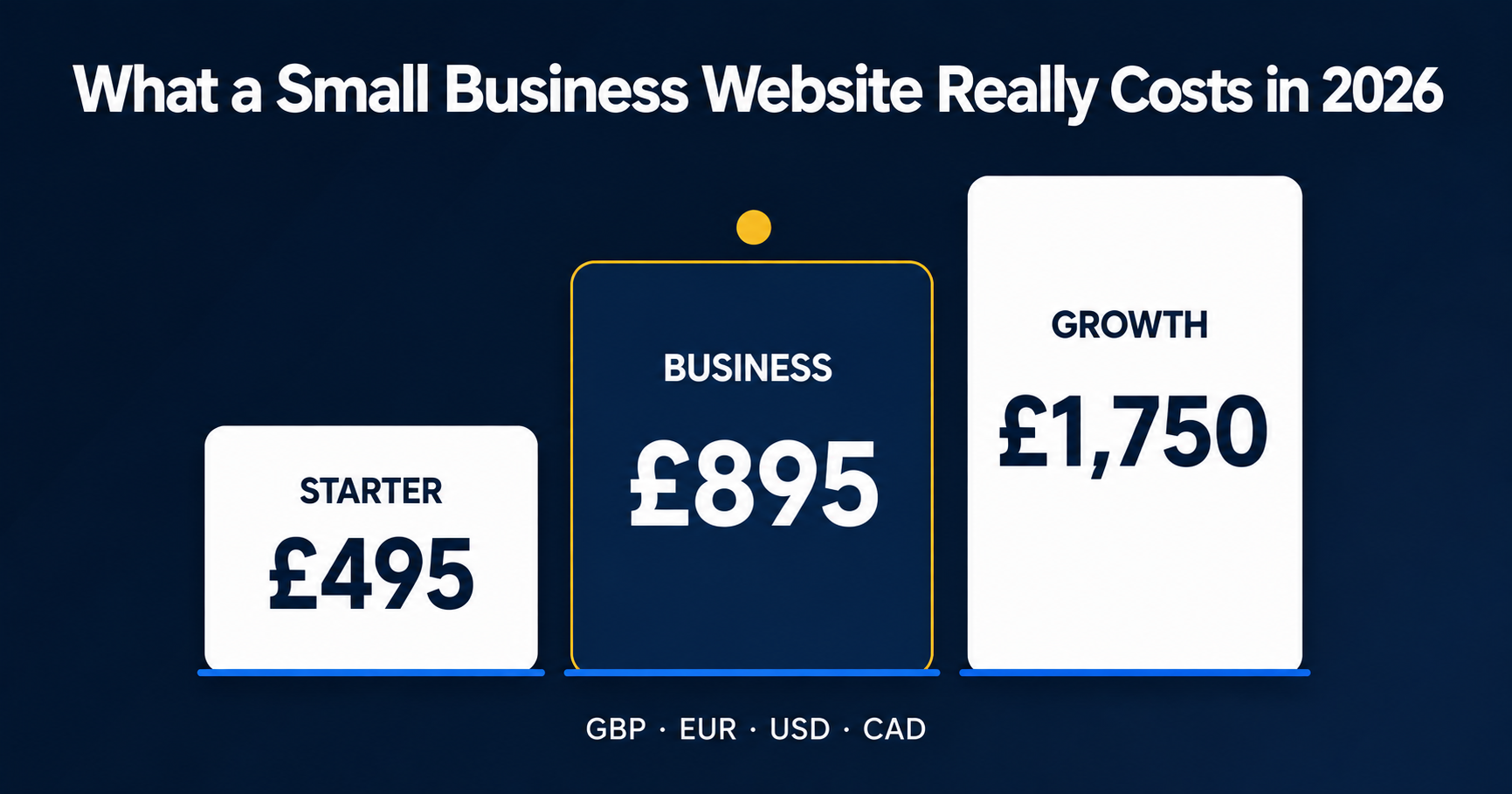
Starter — £495 · €595 · $795 · CA$895
A single, sharp page that gets you found and contacted. One-page mobile-first site, call, WhatsApp and booking buttons, domain and hosting set up for you, Google Business Profile connected, live in about a week.
Business — £895 · €1,050 · $1,395 · CA$1,595
A full site with the pages customers actually look for. Everything in Starter, plus four to six pages including services and gallery, enquiry forms that reach your inbox, local SEO structure and page metadata, and reviews and trust signals built in.
Growth — £1,750 · €2,050 · $2,750 · CA$3,150
For businesses that want the enquiries handled, not just captured. Everything in Business, plus online booking connected to your calendar, automated enquiry replies and follow-ups, written page content for every service, and three months of SEO work after launch.
Compare those to the ranges above and Starter sits below what most UK guides report as the floor for freelance work, while Business lands under what they describe as a typical four-to-five-page freelance build.
Why are we cheaper, and what is the catch?
A fair question, and the honest answer has three parts.
We work remotely, so there is no office, no account manager and no sales team built into your price. We have a defined process rather than reinventing one per project, which removes a lot of billable hours that produce nothing you can see. And we build a free demo before quoting, which means we spend almost no time on proposals, discovery calls and chasing.
What we are not doing is cutting the parts that matter. Mobile-first is not an upgrade. SEO structure is not an upgrade. A working contact method is not an upgrade. Those are in the base price because a site without them does not do its job.
The genuine trade-off is that we are not the right choice for a large bespoke build, a complex ecommerce platform, or a business that wants a named account manager on call. That work exists and it costs what it costs.
The ongoing costs nobody mentions in the quote
The build price is not the whole number. Budget for these regardless of who builds your site.
Domain — roughly £10 to £20 a year, or the local equivalent. Register it in your own business name, not your designer's.
Hosting — anywhere from £50 to £250 a year depending on the site. Some builders include the first year.
Maintenance — updates, backups, security. UK guides typically suggest £100 to £300 a year for a small site. A common industry rule of thumb is 15 to 20 percent of the original build cost annually, though that figure is aimed at larger projects.
Content changes — new prices, new services, new photos. Ask upfront whether small edits are included or billed. This is where surprise invoices usually come from.
A cheap build with expensive locked-in hosting can easily cost more over three years than a dearer build you own outright. Ask for the three-year total, not the launch price.
How to tell if a quote is fair
Five questions worth asking anyone who quotes you.
Is the price fixed, or an estimate? An estimate that can move is not a quote.
Who owns the domain and the site? It should be you. If moving away later means rebuilding from scratch, that is not a website, it is a rental.
What is included after launch, and for how long? Get it in writing.
Can I see the site before I pay? Increasingly you can. There is less reason than there used to be to pay a deposit for something that does not exist yet.
What specifically makes this more expensive than the cheaper quote? A good answer names features. A vague answer about quality or experience usually means overhead.
Frequently asked questions
Is a website worth it if I get all my work by word of mouth?
Usually yes, though not for the reason people expect. A website rarely brings in strangers on its own. What it does is protect the referrals you already earn, because the person your customer recommends you to will search your name before they ring, and a listing with no website sitting next to two competitors who have one loses a fair share of those calls. If you are starting from nothing, our guide to getting a first business website covers what that process looks like.
Is Wix or Squarespace good enough?
For some businesses, genuinely yes. If you have time, some design instinct and a simple offer, a DIY builder will serve you. The costs are your hours and the fact that the result tends to look like everyone else's. If your time is worth more than the difference in price, pay someone.
How long should it take?
A single-page site can be live in about a week. A four-to-six-page site typically takes two to three weeks. Guides commonly cite two to six weeks for freelance work. Anything quoted at several months for a small business site deserves a follow-up question.
Should I pay monthly instead of upfront?
Monthly plans are convenient, but check what happens if you stop paying. Some providers take the site down. If the site disappears when the payments do, you were renting, and after three or four years you will usually have paid more than the outright build cost.
What if I don't like what gets built?
That is exactly why we build a free working demo first. You see the real site on your phone, before any money changes hands, and if it is not right you say so and it costs you nothing.
Not sure what your business actually needs?
The quickest way to find out is to see it. Tell us your business name and what you do, and we will build a free working demo using your real details. No deposit, no contract, and taken down straight away if it is not for you.