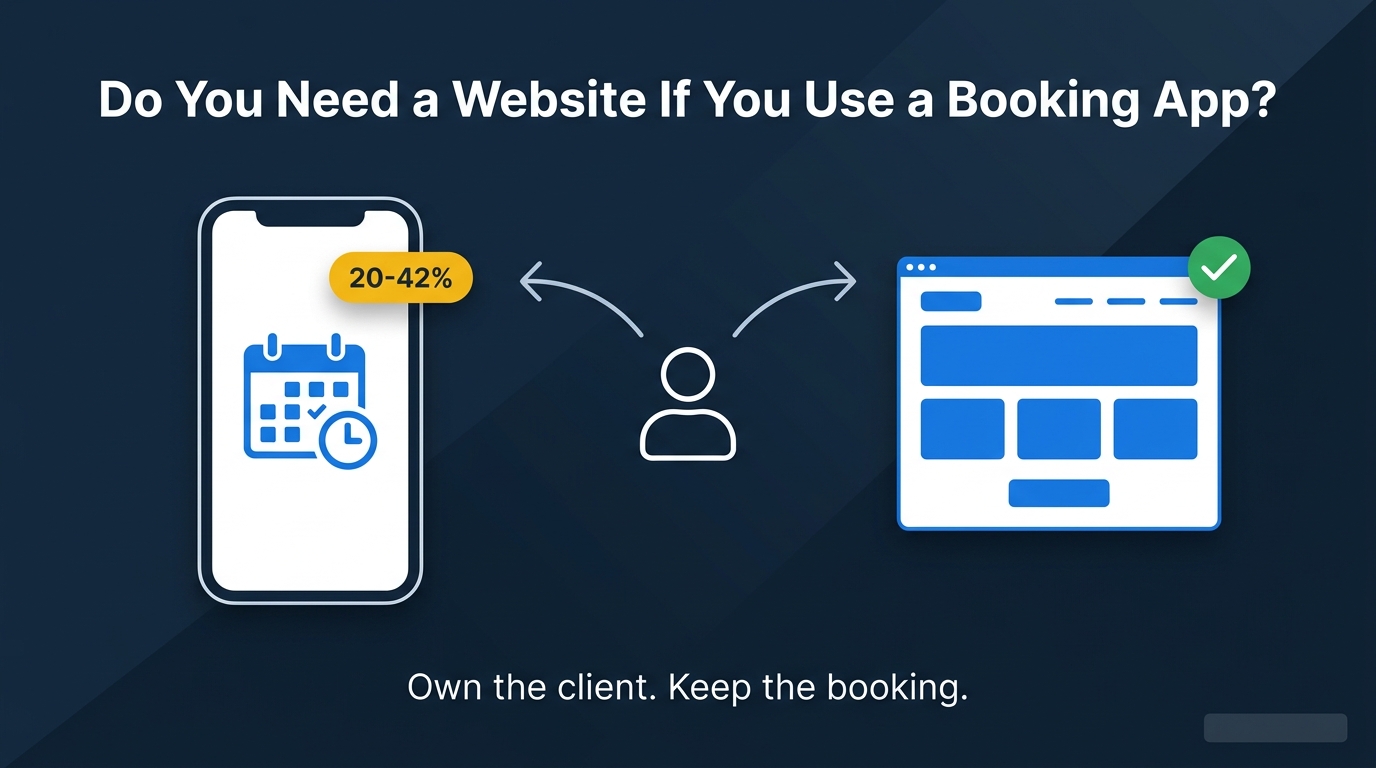
Do You Need a Website If You Use Fresha, Booksy or Treatwell?
Booking platforms handle your calendar brilliantly. What they don't do is own the client relationship on your behalf. Here is what the commission actually costs, what the platform keeps, and why the answer is usually both rather than either.
Article guide On this page
Short answer: yes, but probably not for the reason you are expecting. A website will not replace Fresha, Booksy or Treatwell, and you should not cancel your subscription after reading this. What a website changes is where the next booking starts. On a marketplace, every new client arrives with a fee attached and their email address belongs to the platform. On your own site, they arrive free and they are yours.
This article covers what the platforms genuinely do well, what the commission actually costs over a year, and the part almost nobody mentions until it has already happened.
First, the honest part: these platforms are good
It is worth saying plainly, because most articles on this subject are written by people trying to sell you an alternative.
Booking platforms solve real problems. They stop double bookings. They send the reminder texts that cut your no-show rate. They take deposits. They hold client notes, patch test records and treatment history in one place. They let someone book you at eleven at night when your salon is shut and you are asleep. If you run a busy chair, that is not a nice-to-have, it is the difference between a functioning week and a chaotic one.
And the marketplace genuinely does bring you people who had never heard of you. That has value. Paying an introduction fee for a stranger who becomes a regular is a perfectly sensible trade.
The problem is not the platform. The problem is when the platform is your only front door.
What the commission actually costs
Published rates as of mid-2026, though these change and you should check the current figures before deciding anything.
Fresha charges roughly 20% on a client's first visit when their marketplace introduces someone genuinely new to you. Fresha moved to a paid subscription in 2025, starting somewhere around £15 a month depending on region and team size, so the older "completely free" description is out of date. Clients who book through your own Fresha link cost you nothing.
Booksy does not charge a mandatory new-client fee. Its commission, around 30% of a qualifying first visit, applies only if you switch on the optional Boost visibility feature. Subscription runs from about $29.99 a month for the first user with roughly $20 per additional team member, so cost scales with staff count.
Treatwell charges 35% plus VAT, roughly 42% in practice, on a new client's first marketplace booking, on top of a monthly subscription of around £35. Repeat bookings within 365 days are commission-free.
Two details worth knowing, because they surprise people. Since April 2025, cancelling a marketplace new-customer booking can still trigger the commission. And a client can be counted as brand new all over again if they have not had an appointment with you in 365 days, which means a returning client who drifted away for a year arrives with a fresh fee attached.
Run the numbers on your own salon
Take a UK salon getting fifteen genuinely new marketplace clients a month, average first booking £45, on Treatwell's rate.
£45 × 42% = £18.90 per client. Fifteen clients a month is £283.50. Over a year, that is roughly £3,400.
Now the honest caveat, because this is where these articles usually cheat: a website does not replace those fifteen introductions. Not in month one, and possibly not in year one. Building your own search visibility takes time, and anyone telling you a new site will immediately replace marketplace traffic is selling you something.
What the website changes is the proportion. If even a third of those clients had found you directly instead, through Google, through a friend's recommendation, through your Instagram bio, that is over a thousand pounds a year that stays in your business, permanently, every year after.
The part that costs more than the fee
Here is what the commission table does not show: who owns the client.
When someone books through a marketplace, they are not really your client yet. They are a platform user who happened to sit in your chair. The platform holds their email address. The platform sends the reminders. The platform sends the offers. And the platform sends them suggestions for other salons nearby, because that is what a marketplace is built to do.
You are not building loyalty in that scenario so much as training your client to open an app where your competitors are one scroll away. That is not the platform behaving badly, it is simply what a marketplace is for. But it means the client relationship is rented rather than owned.
The three things a booking profile structurally cannot do for you:
Look like you. Booking pages are designed for consistency across thousands of businesses. Fresha's booking page, for example, cannot be restyled to your branding. Your salon looks like every other salon on the platform.
Rank for your own searches. Someone searching "balayage near me" or your salon name finds the marketplace, not you. The SEO value of that search belongs to the platform.
Give you a direct list. Your own site, with your own enquiry form and your own mailing list, means you can contact your clients without asking permission from a company that also promotes your competitors.
What "own the front door" actually looks like
This is not an either-or decision, and framing it that way is the mistake.
The setup that works for most salons is straightforward. You keep the booking platform, because it is genuinely good at calendars, reminders and deposits. You add a website that owns your brand, ranks for your services and your town, and holds your prices, your gallery, your reviews and your story. Then you point the website's booking button straight at your own booking link, which is commission-free on every platform mentioned here.
The result: new clients from the marketplace still arrive, and you still pay the introduction fee for genuine strangers, which is fair. But clients who find you through Google, Instagram, or a recommendation come through your own front door instead, at no commission, and their details are yours.
Over three or four years, that difference compounds into more than the website ever cost.
Frequently asked questions
Should I cancel Fresha, Booksy or Treatwell?
Almost certainly not. The calendar, reminders and deposit handling are worth paying for, and rebuilding that yourself would cost far more than the subscription. This is about adding a front door, not removing your booking system.
Isn't my Instagram enough alongside the booking app?
Instagram shows your work, which matters enormously in beauty. What it does not do is answer the practical questions that decide whether someone books: your full price list, exactly where you are, your parking situation, your cancellation policy, whether you do the specific treatment they want. It also does not show up in Google searches the way a website does. Keep Instagram, and give it somewhere to send people.
Can my website still take bookings?
Yes, and it should. We connect your existing booking link so clients book through the same system you already use and your calendar behaves exactly as it does now. Bookings made through your own link are commission-free on Fresha, Booksy and Treatwell alike.
How much does a salon website cost?
Our prices are published openly on our pricing page, starting at £495 for a single-page site and £895 for a full multi-page build, with equivalent rates in euros, US dollars and Canadian dollars. For context on what the wider market charges, we broke it down in our guide to what a small business website really costs in 2026.
I have no photos, logo or written content. Can you still build it?
Yes, and that is the usual starting point. We build from your existing booking profile, your Google listing, your reviews and your social pages, and write the page content for you. If you are starting from nothing at all, our guide to getting a first business website covers the process.
Will a website actually bring me new clients?
Over time, yes, but the more reliable benefit comes sooner and is less obvious. A website mostly protects the clients you are already earning through recommendations, because the friend your regular sends will search your name first, and what they find decides whether they book you or the salon underneath you in the results.
See what your salon's website would look like
The quickest way to decide is to look at one. Tell us your salon name and what you offer, and we will build a free working demo using your real services and photos. No deposit, no contract, and taken down straight away if it is not for you.
Commission rates and subscription prices in this article were published by the platforms and independent reviewers as of mid-2026. Fees change, and they vary by country and team size, so check the current figures directly before making a decision.